AI in Production 2026 Speakers
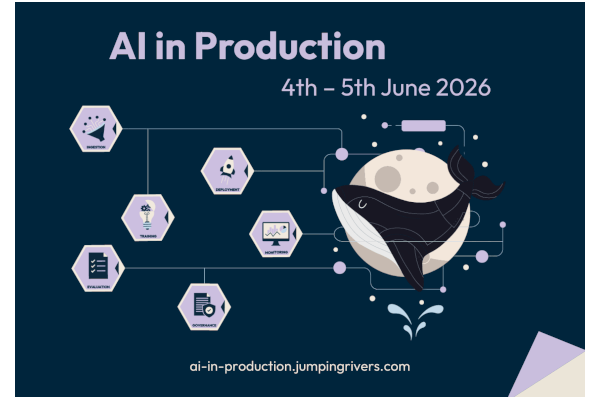
AI in Production is almost here. On 4–5 June at The Catalyst in Newcastle, Jumping Rivers is hosting a day of hands-on workshops followed by a full day of talks from practitioners working with AI across industry, government, academia, and research. You can find the full schedule and registration details on the AI in Production website.
Here is everyone you will hear from.
Workshops: Thursday 4 June
Morning workshops (09:30 – 12:45)
Prompt Craft & AI Integration: Building LLM-Driven Workflows in R and Python Myles Mitchell, Jumping Rivers
If you are new to working with LLMs programmatically or want a cleaner foundation for building workflows, this is a good place to start. Myles will cover how LLMs work, how pricing structures affect practical use, and how to work with APIs using the ellmer and chatlas packages. The session includes structured output formatting and using LLMs to process images and PDFs.
Nothing to Gold: Productionising with Databricks using the Medallion Architecture Declan Watson and Liam Wilkinson, Databricks
A practical session on moving from messy raw data to trusted, production-ready assets using the Medallion Architecture. Expect real patterns from people who run this in production, not a theoretical overview.
Improving your workflow with Positron and AI Kia Mack, Jumping Rivers
Positron is Posit’s next-generation IDE, and this workshop looks at its AI capabilities directly. Kia will demo the Positron Assistant and DataBot, covering how to evaluate AI-generated code, and how to build custom agents and prompts for your own workflows. The demonstrations use R, but everything transfers to Python.
Afternoon workshops (13:45 – 17:00)
Shiny Meets LLMs: Smarter App Experiences Myles Mitchell, Jumping Rivers
A hands-on look at adding LLM capabilities to Shiny applications, from connecting to a model via ellmer and chatlas, to building a chat interface with shinychat, setting up a RAG workflow for domain-specific knowledge, and thinking through safety and responsible use. Code examples in both R and Python.
The Power of Databricks Genie Rooms: Data Discovery and Questions with Minimal Effort Declan Watson and Liam Wilkinson, Databricks
Genie Rooms are designed to let users ask questions of their data without technical overhead. This session covers how the setup works, where it fits in a self-service data strategy, and what it looks like in practice.
Self-hosted LLMs: Running Your Own Inference Infrastructure Daniel Burkhardt Cerigo, datavaluepeople
Not every use case belongs on a third-party API. Data sovereignty, compliance requirements, and cost at scale are all reasons teams move toward self-hosting, and this workshop covers the how. Daniel will walk through deploying a working inference endpoint using open-source frameworks, and dig into the metrics that matter in production: time to first token, tokens per second, and how to tune for your workload.
Dinner Reception: Thursday evening, 17:00 – 19:30
All tickets include the evening reception in the Catalyst atrium, before the conference day on Friday.
Conference Day: Friday 5 June
The talks split across two streams. The Engineering stream covers building, deploying, monitoring, and scaling AI systems. The Machine Learning stream focuses on model development, evaluation, and applied work from real projects.
Opening keynote
Mac Misiura, Red Hat Open Source Guardrails for AI: Securing LLM Applications at Scale
Mac opens the conference with a talk on what it takes to secure LLM applications in production using open-source tooling.
Lightning talks (10:10 – 10:45)
Five short talks follow the opening keynote, before the first coffee break:
- Badr Adnani (Roundel Kitchens Ltd): Breaking Barriers with AI Automation
- Rebecca Guiney (Certara): Learning in Production: Becoming a Software Engineer During the AI Wave
- Obinna Iheanachor (Rotork): RAG in the Real World: Designing Trustworthy LLM Systems for Corporate Insolvency Data
- Diego Jimenez and Oliver Thomas (Sage plc): Beyond the POC: Architecting Enterprise-Grade Agentic Systems
- William Kirby (Wessex Water): Near Real Time Notifications for Bathing Waters using Machine Learning
Joint session
Neal Richardson, Posit Software MCP, or not MCP
Neal looks at the Model Context Protocol and where it actually makes sense to use it, drawing on Posit’s work with data science tooling.
Colin Eberhardt, Scott Logic Agentic AI and the Future of Software Development
Colin works on the intersection of software engineering and AI at Scott Logic. This talk looks at where agentic systems are heading and what that means for how software gets built.
Stream session 1
Engineering: Async Agents in Production: Failure Modes and Fixes Seb Ringrose, Doubleword
Seb covers what actually breaks when you run async agents in production, and the patterns that help.
Engineering: Making Recommendations Explainable Lev Fedorov, Amazon
Recommendation systems are everywhere, but explainability is still an open problem. Lev brings an Amazon perspective on the approaches that work.
Machine Learning: Comparing and Evaluating Large Language Models for Efficient and Responsible Data Rescue Shona Ferguson, UK Centre for Ecology and Hydrology
Shona works on using LLMs to recover and digitise legacy scientific data. This talk covers how she evaluates models for this kind of work, where accuracy and efficiency trade off, and what responsible use looks like outside of commercial contexts.
Machine Learning: A Nerd’s Eye View: Wrangling the GenAI Hype Cycle Izzie Johnson and Damani Richards, Wordnerds
Izzie and Damani have spent the past few years running a text analytics company while the world around them pivoted to GenAI. This talk is about how they made their tooling faster, leaner, and more efficient without losing what made it useful, and about keeping a clear head when everyone is shouting about transformation.
Stream session 2
Engineering: Building Agentic AI Workflows with xAI on Google Vertex AI Manai Mohamed Mortadha, Netflix
Manai covers the architecture and trade-offs involved in building agentic workflows at Netflix, using xAI tooling on Google Vertex AI.
Engineering: Engineering a Scalable Knowledge Graph Builder on Neo4j Cloud Jonny Law, Neo4j
Jonny walks through the engineering side of building a knowledge graph system that works at scale, using Neo4j’s cloud platform.
Machine Learning: From Risks to Insights: Driving Innovation with AI-Powered Tools in Internal Audit Katy Morgan, Government Internal Audit Agency
Katy looks at how AI tooling is changing the work of internal audit in government, what the risks are, and how the Government Internal Audit Agency is approaching them.
Machine Learning: AI Beyond Industry: Insights from Higher Education and Government Nayara Macedo de Medeiros Albrech, Newcastle University
Nayara brings perspectives from higher education and public sector AI deployment, covering what is different about these contexts compared to commercial AI work.
Stream session 3
Engineering: You Don’t Need Less Discipline to Use AI, You Need More Juan Rodriguez, Opencast
The title says it. Juan argues that teams which struggle with AI are usually struggling with the same things they struggled with before it.
Engineering: Building Autonomous Personalisation Systems: Reinforcement Learning and AI Agents in Production Aura Arefeh Yavary, University of California Davis
Aura covers reinforcement learning approaches to personalisation and what it takes to run these systems reliably in production.
Machine Learning: Using Deep Learning to Monitor Player Safety on Online Betting Platforms Myles Mitchell (Jumping Rivers) and Grant Beasley (tombola)
Myles and Grant look at how deep learning is being used to identify players at risk on betting platforms, combining research with real deployment experience from tombola.
Machine Learning: The Regulatory Issues to Be Aware of When Working with AI Nathan Bilton, Weightmans LLP
Nathan covers the regulatory landscape for AI from a legal perspective, including what teams actually need to know and where the meaningful compliance questions are.
Closing keynote
George Stagg, Posit Software Effective Agents: A Builder’s Guide to Working with AI
George closes the conference with a practical guide to building with AI agents, based on hands-on work at Posit.
Register
General registration is open until 28 May. Tickets cover the conference day on Friday, with an option to add a workshop day. The dinner reception on Thursday evening is included with all tickets.
Questions? Email events@jumpingrivers.com{.email}.